

You’re not just its owner, you’re its custodian.
Many of Chelsea’s homes were built in the eighteenth and nineteenth centuries, and much of the borough lies in conservation areas. What you see from the street (the brickwork, railings and sash windows) is only half of that heritage. Beneath and behind your home is a drainage system that is often just as old, and just as carefully designed.
Drainage built to a London pattern
After the “Great Stink” of 1858, London rebuilt its drains. Joseph Bazalgette’s sewers, built for the Metropolitan Board of Works, carried waste away from the Thames. The rules for how each house connected to them were set by the Board and, from 1889, by the London County Council (LCC). The result was a pattern of house drainage that builders across London followed for decades, and that plumbers still call “LCC”.
If your home has original drainage, you’ll probably find some of these:
- Cast iron soil stacks, often with bolted access doors for rodding.
- An intercepting trap, usually in a manhole near the front boundary, which stops sewer gases coming back into the house drains.
- A fresh air inlet: a small grille with a hinged mica flap, often on a front wall or railing, which lets air into the drain but not out.
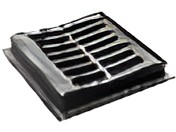
- Cast iron gullies, gratings, hoppers and air bricks, many of them still the originals.




Signs it needs some attention
- A drain smell near the front of the house: the mica flap may be stuck, cracked or missing.
- Slow drains or repeated blockages, often at the intercepting trap.
- Cracked, rusted or leaking access doors, or missing bolts and seals.
- Broken gratings or gully covers.
Repair, don’t rip out
It’s tempting to replace old cast iron with plastic. But repairing like for like keeps the character of your home, is often what conservation officers expect to see, and can be simpler than you think, as long as your builder can get the parts. Where a new section really is needed, there are adaptors to join cast iron and clay to modern pipe neatly.
If your home is listed or in a conservation area, check with the Royal Borough of Kensington and Chelsea before changing anything visible from outside.
What we supply for your builder
We stock the cast iron and LCC-pattern parts that period London homes need, and plenty that most merchants stopped carrying years ago. Pass this page to your builder or plumber. They can order online, or call us to check a part.
- Intercepting trap (150mm)
- Fresh air inlets with mica flaps
- LCC access doors, right hand
- LCC access doors, left hand
- Bolts for LCC access doors
- Cast iron access pipe
- Cast iron rectangular hoppers
- Cast iron S-trapped gully
- Pig lead ingots, for caulked joints
Browse the full ranges:
- LCC soil & waste, and fresh air inlets
- Cast iron soil & waste
- Cast iron underground pipe
- Cast iron downpipes & hoppers
- Cast iron gratings
Not sure what you have?
Send us a photo with a few measurements and we’ll help identify it. Many parts we don’t list online can still be found. Contact us.